🤖 Rare Humanoid Stability

Good Morning, Roboticists!
Humanoid robots are finally learning how not to fall, and that quiet breakthrough may matter more than any flashy demo.
HUMANOIDS
Oli Shows Rare Humanoid Stability on Real Terrain
👀 What’s happening: LimX Dynamics released new footage of its full size humanoid Oli calmly walking across sand, loose gravel, flexing planks, and scattered rubble. No safety tethers. No stop-start panic. Just continuous balance corrections driven by a 31 joint control stack, dual depth cameras, and a dedicated motion tracking unit. LimX is positioning Oli as an open development platform, complete with a modular SDK and simulation support.
🔥 How this hits reality: Steady locomotion on deformable terrain is the part of humanoid robotics that almost everyone claims and almost no one demonstrates. Rocks and shifting sand expose control logic faster than any benchmark. Oli’s run is notable because it shows sustained stability rather than a lucky step sequence. That places it in a very small club of robots that can handle real world surfaces without choreography and marks a rare breakthrough in the only capability that actually governs field deployment.
🤖 Our take: When a humanoid treats shifting rubble as normal ground, it joins a club so small it barely exists, and the field finally feels closer to real life.
GRIPPER
Vine Robot Solves What Grippers Won’t
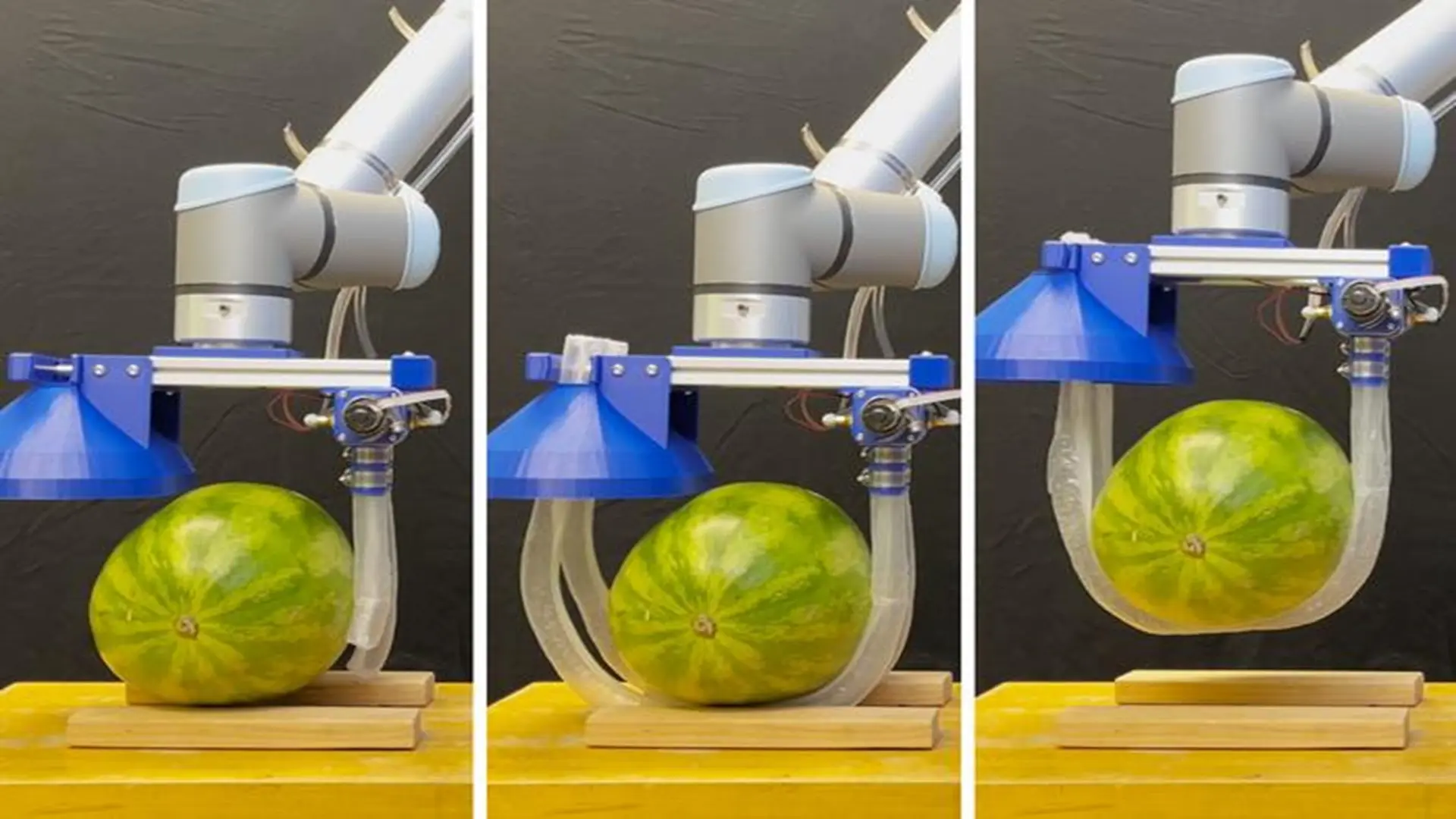
👀 What’s happening: MIT and Stanford engineers turned garden-vine mechanics into a soft robotic system that literally grows around objects. These inflatable “robo tendrils” extend, twist, wrap, and then lock into a closed loop that can cradle everything from a glass vase to a human body. The robot can snake under a patient in bed, reconnect with its base, and then lift them with a winch like a pneumatic hammock. Smaller versions slide onto robot arms for cluttered pick work.
🔥 How this hits reality: Most grippers are either rigid enough to hold weight or soft enough not to break things, but rarely both. This design cheats by outsourcing strength to geometry. The vine does not squeeze; it envelops. That makes it a real contender for eldercare transfers where fatigue, injury, and liability kill most deployment attempts. It also hints at a new category of “adaptive sling robotics” for logistics, agriculture, and recovery tasks that do not fit the usual parallel-jaw playbook.
🤖 Our take: If robot hands cannot get smarter, turning them into inflatable vines that do not need dexterity is a perfectly pragmatic workaround.
SAFETY
Japan Uses Robo Wolves to Police Its Bear Problem

👀 What’s happening: Japan is deploying three hundred Monster robot wolves across rural regions after a surge in deadly bear encounters. The robots are not high-tech automatons. They are infrared-triggered deterrence machines that flash red eyes, swivel their heads, and blast fifty random high-volume sounds to scare off bears before they reach farms or villages. First dismissed as countryside kitsch, the trials proved effective enough that municipalities are lining up to buy them.
🔥 How this hits reality: This is the side of robotics people ignore because it does not win CES. No AI inference stack, no humanoid gait, no viral demo, just a rugged, cheap, never-off-duty machine filling a public safety gap that humans and budgets can no longer cover. Monster Wolf works because it respects field physics: simplicity, reliability, and psychological leverage against wildlife. While animal habituation will eventually erode the effect, the device already solves a problem that glossy robots cannot even deploy for.
🤖 Our take: Field robotics is won by usefulness, not spectacle. That is why a crude wolf with sensors gets deployed while many cutting edge robots still struggle to matter outside their demos.
QUICK HITS
- Osaka Metropolitan University’s “harvest-ease” model helps robots pick tomatoes more accurately.
- MMI’s NanoWrist tools gained FDA clearance, allowing the Symani robot to complete its first U.S. soft-tissue microsurgery.
- LimX Dynamics revealed new footage of its humanoid robot Oli walking stably over rubble and shifting terrain with human-like balance.
- Inbolt launched a real-time vision-guided bin-picking system that uses on-arm 3D cameras and proprietary AI to grasp parts quickly in unstructured bins.
- Agility Robotics and Mercado Libre will pilot Digit robots in Texas, signaling a shift toward scalable, safety-certified humanoids in real logistics operations.
TOGETHER WITH US
AI Secret Media Group is the world’s #1 AI & Tech Newsletter Group, reaching over 2 million leaders across the global innovation ecosystem, from OpenAI, Anthropic, Google, and Microsoft to top AI labs, VCs, and fast-growing startups.
We operate the industry’s most influential portfolio of newsletters, each shaping a different frontier of the AI & Tech revolution:
Be Smarter in 5 Minutes
- AI: AI Secret
- Tech & Business: Bay Area Letters
- Marketing: Marketing Secret
Discover the Future Products
- AI Launchpad: Oncely
- Robotics: Robotics Herald
- Hardwares: The Hardwire
We've helped promote over 500 Tech Brands. Will yours be the next?
Email our co-founder Mark directly at mark@aisecret.us if the button fails.