🤖 Stanford New Control Brain

Good Morning, Roboticists!
Robot intelligence is moving closer to the physical world, faster, messier, and far more scalable than before.
NEW LAUNCH
Robots Stop Just Thinking In Language
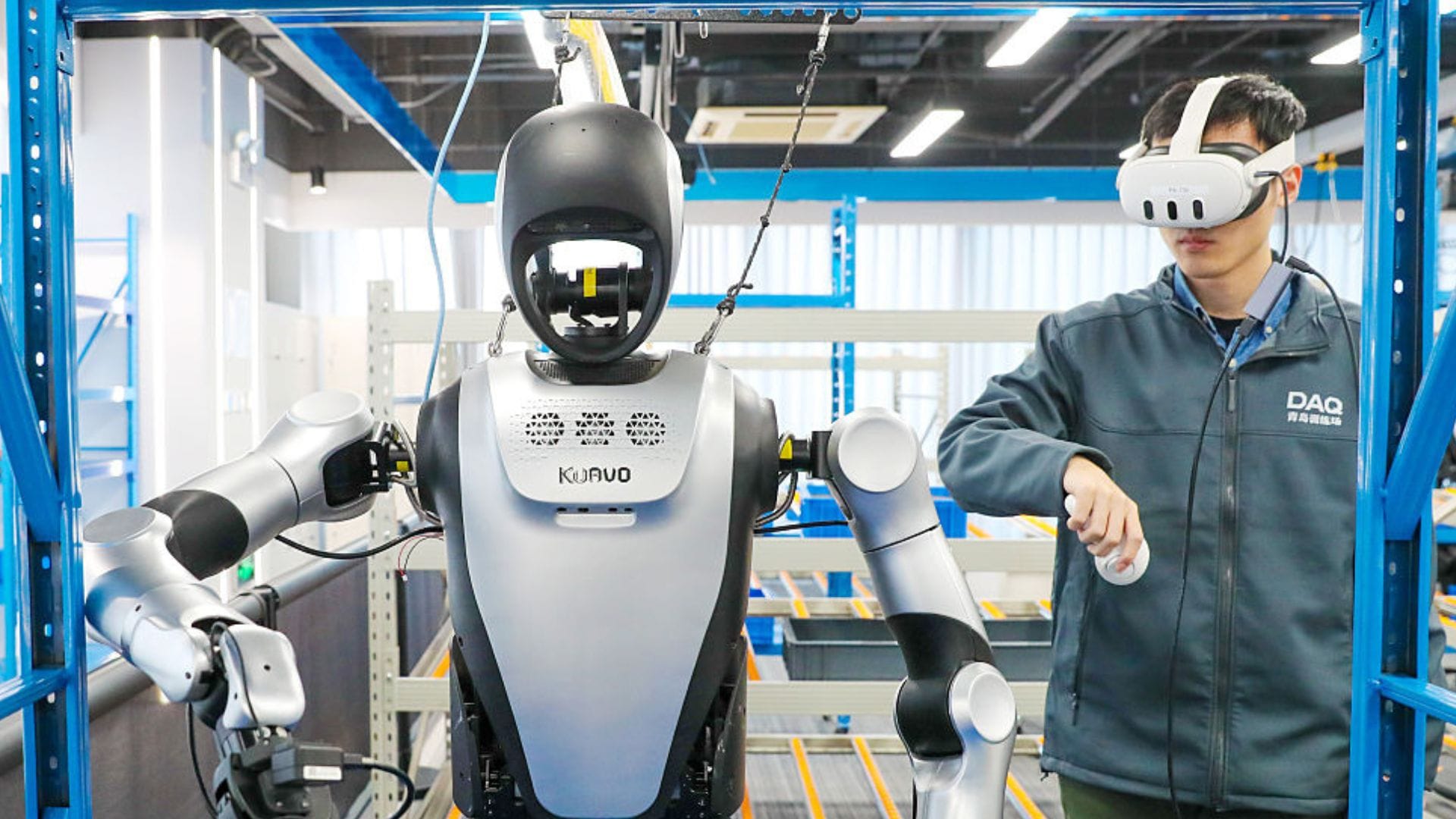
👀 What’s happening: Nvidia and Stanford University released Cosmos Policy, an opensource robot control model built directly on a video generation backbone. Instead of mapping vision into language and then into actions like traditional Vision-Language-Action (VLA) systems, it treats actions, robot state, and future outcomes as video tokens inside one diffusion model. Planning, control, and prediction happen in a single pass.
🌍 How this hits reality: This does not replace VLA systems. It sidesteps them. VLA remains strong at semantic grounding, task intent, and abstraction. Cosmos targets what VLA struggles with: soft objects, slippery contacts, ambiguous grasp choices, and long horizon physical interactions. With as few as 50 demonstrations per task, it outperforms language based policies in kitchens, folding clothes, and sealing bags. That stresses current assumptions about data scale, modular pipelines, and language centric control.
🤖 Key takeaway: Robot stacks are splitting. Language models handle intent and abstraction. Video models absorb low level physical intelligence. If this holds, robotics progress will hinge less on promptability and more on video compute, simulation depth, and GPU bound training economics.
NEW TECH
Underwater Concrete Printing Leaves the Lab
👀 What’s happening: A research team at Cornell University has shown a 6000 pound industrial robot arm can 3D print concrete directly underwater. The system deposits stable layers in water tanks using modified mixtures. It responds to a Defense Advanced Research Projects Agency challenge to build subsea structures fast without heavy marine disruption.
🌍 How this hits reality: Undersea cables, ports, and energy links fail slowly and cost billions to repair. Printing in place cuts vessels, divers, and weeks of downtime. DARPA also forces use of seafloor sediment, reducing cement logistics and emissions while stressing robotics, sensing, and material control.
🤖 Key takeaway: This is less about construction and more about autonomous manufacturing in hostile environments. If it scales, underwater printing becomes infrastructure maintenance on demand, shifting subsea work toward robots, sensors, and local materials with chain implications.
TRAINING
Project Genie Rewrites How Robots Get Trained
👀 What’s happening: Google DeepMind has pushed Project Genie from a research preview into a public prototype, exposing Genie 3 as an interactive world model. It generates explorable 3D environments on demand and lets simulated agents act inside them. This is not a static simulator release. It is a live system designed to produce endless training worlds.
🌍 How this hits reality: Robot training has been bottlenecked by data collection. Real hardware is slow, fragile, and expensive. Genie changes the unit economics. Instead of recording thousands of real demonstrations, agents can practice millions of motion variations in synthetic worlds. Training shifts from scarce physical trials to abundant simulated experience. Hardware becomes validation, not curriculum.
🤖 Key takeaway: This marks a structural shift. Robot learning starts decoupling from real-world data collection. If simulation quality keeps improving, control over world models becomes a choke point for humanoid progress, supply chains, and who scales physical AI fastest.
QUICK HITS
- Tesla plans to build Optimus in the US, but its humanoid robot program still relies heavily on Chinese component suppliers.
- NVIDIA’s GR00T N1.6 surpassed 4.8 million downloads, advancing an “Android of robotics” strategy around open models and compute platforms.
- Unbox Robotics raised $28 million in Series B funding to scale its swarm-intelligence warehouse robotics platform across India and global markets.
- AI-powered surgical robots are rolling out across the NHS, cutting hospital stays from days to hours.
- UCLA researchers introduced a dog-training-inspired framework that enables quadruped robots to learn new skills through touch, gestures, and verbal commands.
READ MORE
Let the Future Come to Your Inbox
Stay ahead without drowning in information. We turn the most important signals across AI, tech, marketing, and future products into 5-minute reads you can actually finish.
- AI Secret uncovers what really matters in AI
- Bay Area Letters decodes tech and business shifts from Silicon Valley
- Robotics Herald tracks how robots move from labs into daily life
- Marketing Secret breaks down real growth and go-to-market playbooks
- The Hardwire explores hardware, consumer tech, and what’s coming next
- Oncely helps you discover the next wave of AI products and launches
TOGETHER WITH US
AI Secret Media Group is the world’s #1 AI & Tech Newsletter Group, reaching over 2 million leaders across the global innovation ecosystem, from OpenAI, Anthropic, Google, and Microsoft to top AI labs, VCs, and fast-growing startups.
We've helped promote over 500 Tech Brands. Will yours be the next?
Email our co-founder Mark directly at mark@aisecret.us if the button fails.