🤖 Too Real

Good Morning, Roboticists!
The EngineAI humanoid’s arm moved, and it struck the person least expected: its own CEO.
HUMANOIDS
EngineAI Proves the T800 Is Real, Maybe Too Real
👀 What’s happening: To counter claims that its T800 robot videos were CGI, EngineAI’s CEO literally stepped into the frame, and the line of fire. In a new clip, the 75-kilogram robot lands a clean side kick on its armored boss, sending him staggering back while cameras roll. It’s visceral proof that the machine can generate 450 N·m of torque. It’s also proof that someone in marketing forgot what “risk management” means.
🔥 How this hits reality: The stunt achieves its goal. nobody doubts the T800’s power or balance now. But it also plants a new question in every factory manager’s head, if this thing can floor a human, what happens when it misfires near a worker with no body armor? In trying to show control, EngineAI highlighted the opposite: that even a well-tuned actuator can turn dangerous when repurposed for drama. Industrial robotics lives or dies on trust, and trust is hard to build when your CEO’s wearing body armor.
🤖 Key takeaway: EngineAI proved its robot isn’t fake; just maybe too strong for a factory floor with humans in it.
HORROR
The Future of Horror Just Learned to Crawl
Quick clip of the final full-speed crawl (no costume) pic.twitter.com/GzIO49UEgh
— Logan Olson (@jloganolson) November 4, 2025
👀 What’s happening: Engineer Logan Olson has turned the Unitree G1 humanoid into something out of a nightmare. Using an AI “crawl policy,” he trained the robot to drop to all fours in under a second and move like an animal—fast, fluid, and wrong in all the right ways. When Olson put a Halloween mask on it, the line between robotics demo and horror short disappeared. The clips went viral immediately.
🔥 How this hits reality: This isn’t about locomotion anymore. It’s about emotion—specifically, fear. The same low-cost hardware and AI control systems that power industrial robots are now capable of simulating pure primal unease. Horror filmmakers, haunted house operators, and immersive theater designers just found their perfect cast: mechanical performers that never blink, never need direction, and can crawl straight out of the uncanny valley at 3 a.m.
🤖 Key takeaway: Forget CGI monsters; the next scream factory runs on lithium batteries and a crawl policy.
HUMANOIDS
Midea’s Six-Armed Humanoid Pushes Efficiency Over Elegance
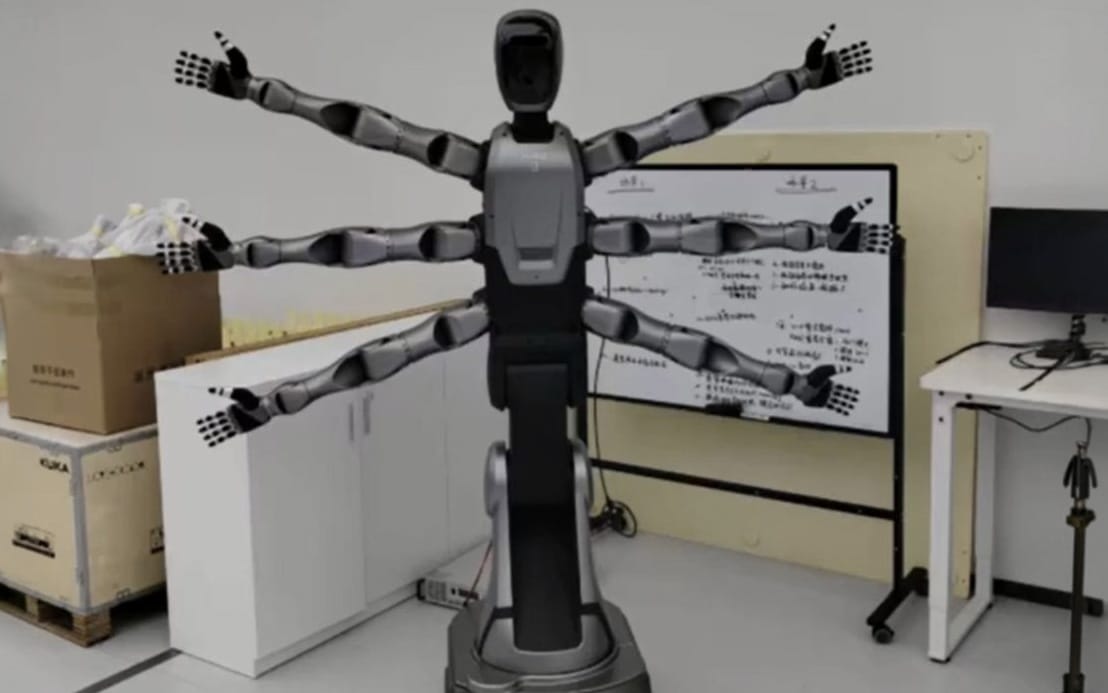
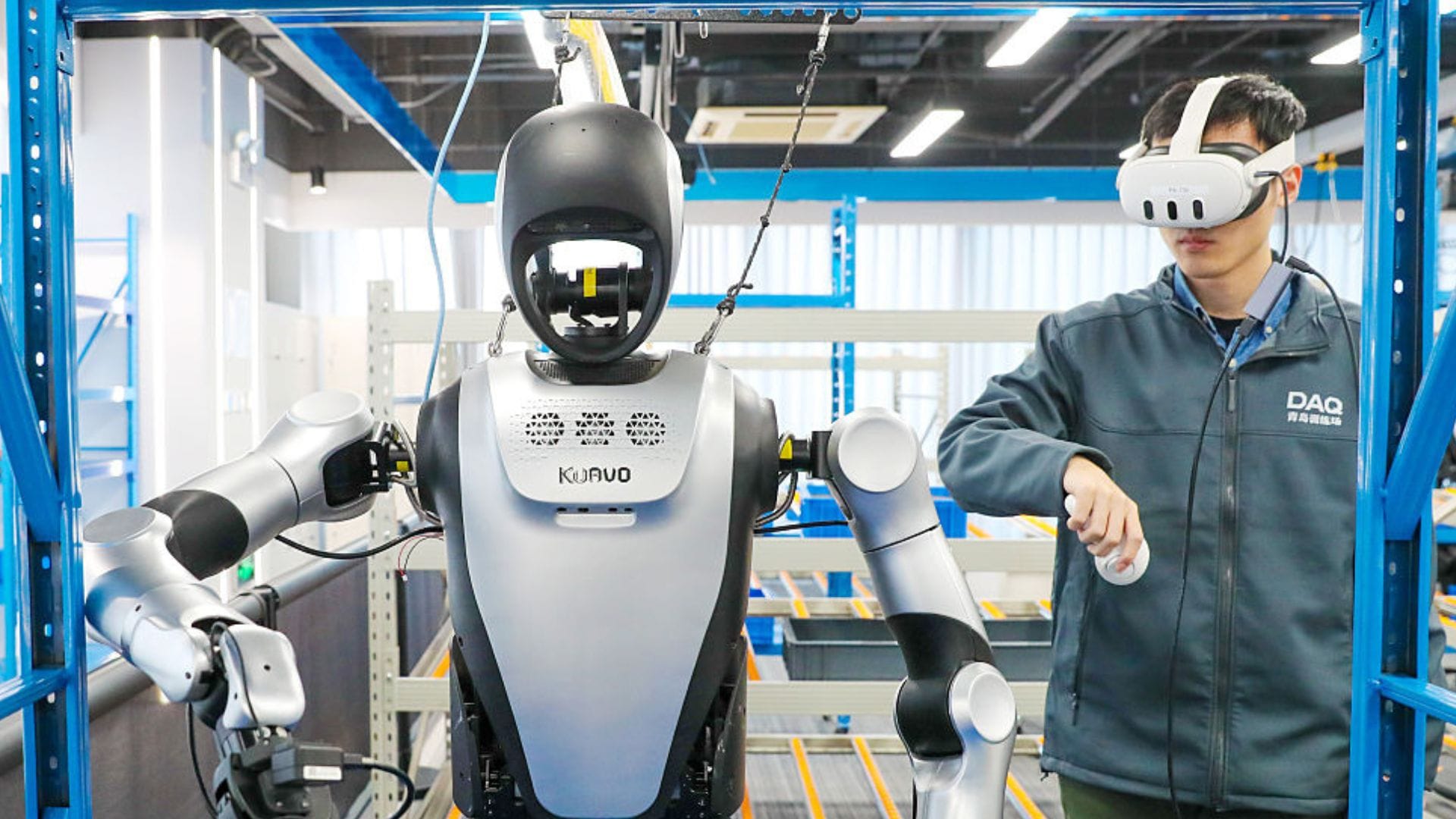
👀 What’s happening: At the China Greater Bay Area New Economy Forum , Midea, one of China’s largest home appliance manufacturing giants, unveiled MIRO U, a so-called “super humanoid” equipped with six bionic arms and a wheeled chassis. The robot keeps a humanoid torso and head for workstation compatibility but adds two extra pairs of limbs to juggle parallel tasks—lifting, tightening, and aligning components all at once. It’s slated to enter Midea’s Wuxi washing-machine factory this month, aiming to boost production-line changeover efficiency by 30 percent.
🔥 How this hits reality: MIRO U’s design philosophy is simple: if two hands are good, six are better. Each limb cluster serves a distinct purpose—lower arms for heavy loads, upper ones for precision, and middle ones for coordination. The result looks less like a colleague and more like a mechanical demigod built for takt time. Midea isn’t chasing anthropomorphism; it’s chasing throughput. In the factory, balance sheets matter more than balance of form, and this robot makes that brutally clear.
🤖 Key takeaway: Midea’s robot doesn’t dream of being human; it dreams of doing more work per minute.
QUICK HITS
- Unitree’s new demo shows its full-size H2 robot performing combat moves while revealing teleop and hardware upgrades.
- Pickle’s AI-driven robot unloads up to 1,500 boxes per hour in extreme heat, as new funding fuels broader logistics and supply-chain expansion.
- EPFL researchers used discarded langoustine shells to create functional robot parts, showcasing a circular bio-based design.
- The UMBC team used Indian dance mudras to derive richer hand-motion patterns for better robotic hand learning.
- UCLA achieved the first robotic-assisted cataract surgery with 0.053 mm precision, marking a major step toward automated ophthalmic procedures.
TOGETHER WITH US
AI Secret Media Group is the world’s #1 AI & Tech Newsletter Group, boasting over 2 million readers from leading companies such as OpenAI, Google, Meta, and Microsoft. Our Newsletter Brands:
- AI: AI Secret
- Tech & Business: Bay Area Letters
- Robotics: Robotics Herald
- Marketing: Marketing Secret
We've helped promote over 500 Tech Brands. Will yours be the next?
Email our co-founder Mark directly at mark@aisecret.us if the button fails.