🤖 Worlds for Robots

Good Morning, Roboticists!
Robots are no longer just learning how to move; they’re learning where they belong.
TRAINING
Video Labs Rush to Build Worlds for Robots
Generalist robots need a generalist evaluator. But how do you test safety without breaking things? 💥
— Anirudha Majumdar (@Majumdar_Ani) December 12, 2025
🌎 Introducing our new work from @GoogleDeepMind:
Evaluating Gemini Robotics Policies in a Veo World Simulatorhttps://t.co/ZjvpYXFddZ
🧵👇 pic.twitter.com/h2ZbeEKYEn
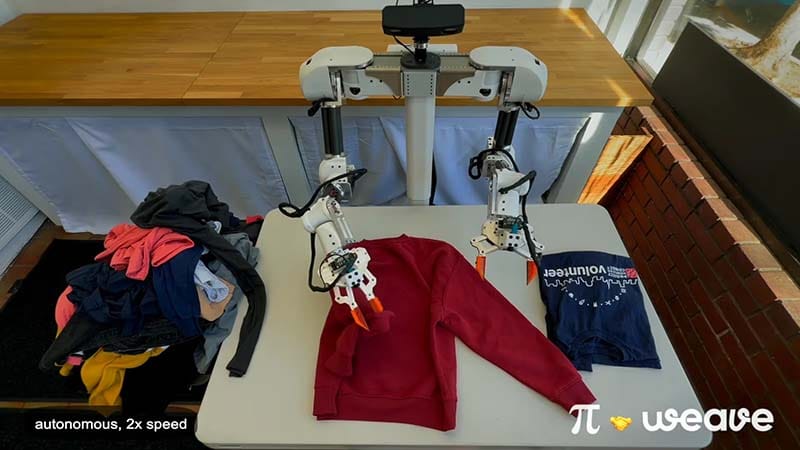
Google DeepMind just announced breakthroughs in video generation, unveiling systems that can produce long, physically consistent scenes from text prompts. It claims these synthetic worlds could train general-purpose robots entirely in simulation, no sensors, no broken prototypes, no lab accidents. The idea echoes moves by Luma AI and others positioning video models as large-scale “world models” for robot learning.
In truth, these generated worlds don’t yet mirror reality; they mimic it just enough for pattern learning. The models can teach robots to recognize cause and effect or anticipate motion, but they can’t yet replicate friction, force, or feedback loops. What we have are visually coherent training clips, not fully simulated physics engines. Still, it’s a crucial bridge toward data-driven autonomy.
These “world models” are less alternate realities than animated textbooks, good for teaching robots what to expect, not how to act. Reality still writes the final exam.
INNOVATION
Snail-Bots Build, Climb, and Dissolve
The Robotics and AI Lab at CUHK Shenzhen has unveiled a swarm of dome-shaped “snail robots” that can link, stack, and detach like living tissue. Each palm-sized unit moves via a magnetic track, then switches to vacuum suction when it needs to hold weight. In a demo, five robots built a temporary ramp out of themselves so one could climb higher, before all split apart and rolled away independently.
These spherical modules show what happens when robots stop being fixed machines and start becoming adaptive materials. They can self-assemble into bridges, stairs, or supports in rescue missions or remote construction sites, anywhere the environment refuses to cooperate. CUHK’s team is essentially teaching robots to build their own tools, one shape at a time.
The future of robotics isn’t just big brains; it can be small bodies that know when to stick together.
EXOSKELETON
Exoskeleton Helps MND Patients Keep Walking
The University of Queensland has begun the world’s first trial of a robotic ankle exoskeleton for people with motor neuron disease (MND). The untethered device uses sensors and lightweight motors to assist ankle motion during walking, reducing fatigue and extending mobility. Following the success of its first prototype, researchers have now developed a second-generation version that integrates machine learning to personalise support, adapting assistance based on each user’s gait and environment.
Unlike rehab-focused exosuits for post-injury recovery, this one targets degenerative decline, an entirely different problem. By combining biomechanics, wearable robotics, and AI-driven gait analysis, the device shifts from therapy to sustained autonomy. If proven effective, it could delay wheelchair dependence for MND patients and redefine how exoskeletons are applied in chronic disease management rather than short-term rehab.
When assistive robots start learning from the body they’re meant to support, rehabilitation turns into co-evolution that man and machine training each other.
QUICK HITS
- Texas Instruments is deploying UBTECH’s Walker S2 humanoid robots in its fabs under a two-way strategic partnership.
- X-Humanoid uses generative video models to convert human action videos into humanoid robot videos at scale for training robotic systems.
- WuBa Intelligent Tech is pushing its Da Sheng D12 humanoid into industry following a $5.5 million order.
- Milagrow, an Indian home and service robotics company, has launched three humanoid robots for home, education, research, and public service use.
- French AgTech startup Agreenculture has raised €6 million in Series A funding to scale its plug-and-play autonomy kits for agricultural machinery.
TOGETHER WITH US
AI Secret Media Group is the world’s #1 AI & Tech Newsletter Group, reaching over 2 million leaders across the global innovation ecosystem, from OpenAI, Anthropic, Google, and Microsoft to top AI labs, VCs, and fast-growing startups.
We operate the industry’s most influential portfolio of newsletters, each shaping a different frontier of the AI & Tech revolution:
Be Smarter in 5 Minutes
- AI: AI Secret
- Tech & Business: Bay Area Letters
- Marketing: Marketing Secret
Discover the Future Products
- AI Launchpad: Oncely
- Robotics: Robotics Herald
- Hardwares: The Hardwire
We've helped promote over 500 Tech Brands. Will yours be the next?
Email our co-founder Mark directly at mark@aisecret.us if the button fails.